


Choosing PU Anti-Sprial Hose: Medium, Dimensions and Operating Conditions
THE BUYER'S GUIDE / SELECTION
Choosing PU Anti-Sprial Hose: Medium, Dimensions and Operating Conditions
A buyer-focused guide to selecting PU Anti-Sprial Hose from Hebei Kebing Import and Export Trade Co., LTD. It covers the conveyed medium, the listed inner diameters and roll lengths, the published temperature range, and the points buyers should confirm before ordering. It also explains when a pressure-rated PU braided hose may be the better option.

Conveyed medium: published for abrasive solids, sand, gravel, grains, particulates and static-generating materials. Chemical compatibility must be confirmed for the specific medium.
Static control: described as anti-static, but no electrical resistance value or grounding method is published. Confirm before use with combustible dust.
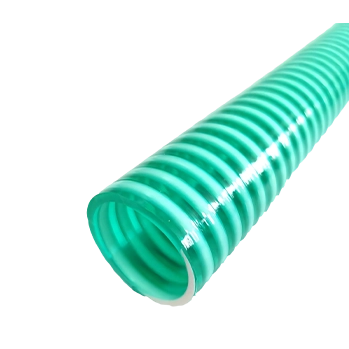
Construction: transparent polyester polyurethane wall with an external rigid PVC spiral and a wall thickness of 0.6–2.0 mm. The source also mentions 'top platinum silicone', so the wall material needs written confirmation.
Inner diameter: listed sizes from 20 mm to 250 mm, including inch-equivalent sizes.
Roll length: the table appears to show 20 m rolls up to 102 mm ID and 10 m rolls from 102 mm upward. Confirm for the chosen size.
Vacuum rating and bending radius: columns are listed, but the headings, units and values do not line up clearly. Ask for a per-size data sheet.
Temperature: -40 °C to 90 °C, with up to +150 °C for a short, unspecified time.
Pressure requirement: no positive working or burst pressure is published. Pressure-rated duties need a different hose.
PU Anti-Sprial Hose from Hebei Kebing Import and Export Trade Co., LTD is a transparent polyurethane hose with a rigid PVC spiral on the outside. It is listed for moving abrasive solids and particulate matter. This guide uses the published product information to set out what buyers should check before they choose this hose. It covers the medium, the dimensions and the operating conditions, and it points out where the published data is not enough to decide.
1. Start with the medium
The product description says PU Anti-Sprial Hose is especially suitable for:
- abrasion-resistant solids
- uncertain media such as sand, gravel, grains and other particulate matter
- materials that generate static electricity
The product page also says the inner wall is very smooth and lists acid, alkali and chemical resistance.
What to confirm: The published material does not name specific chemicals, concentrations or exposure times. If your medium contains acids, alkalis, solvents or oils, send the exact composition and ask for written confirmation of compatibility before you order. The page calls the hose "anti-static" and says it suits static-generating materials, but it gives no electrical resistance value and no grounding method. If static control matters for safety, for example with combustible dust, ask for the electrical specification and grounding guidance first. Do not treat the product name alone as proof of static performance.
2. Check the construction
The published construction is:
- Wall: polyester polyurethane, transparent
- Spiral: rigid PVC, on the outside as reinforcement
- Wall thickness: 0.6–2.0 mm
The transparent wall lets operators see the material moving through the hose. The outer spiral adds reinforcement and keeps the inner bore smooth.
What to confirm: A short summary on the same product page describes the wall as "top platinum silicone", while the full description gives polyester polyurethane. Ask the supplier to confirm the wall material in writing, because this affects chemical and temperature suitability.
3. Match the dimensions
The size table lists inner diameters from 20 mm to 250 mm. These include 20, 25, 30, 31.8, 35, 38.1, 40, 45, 50.8, 55, 60, 63.5, 65, 76.2, 80, 90, 100, 102, 120, 127, 152, 200 and 250 mm. Several of these are inch-equivalent sizes, such as 38.1, 50.8, 63.5, 76.2, 102, 127 and 152 mm, which helps when you match imperial fittings.
The table shows 20 m rolls for sizes up to 102 mm and 10 m rolls for 102 mm and larger. The 102 mm size is listed in both lengths. The table also has columns for thickness, vacuum pressure and bending radius.
What to confirm: Before you order, ask for a clean data sheet for your chosen inner diameter. It should show the wall thickness, the vacuum rating with its unit, the minimum bending radius and the roll length. Also check that your clamps or couplings fit the hose's outer profile over the spiral.
4. Check the operating temperature
The published temperature range is -40 °C to 90 °C. The product summary says the hose can reach +150 °C for a short time. It does not say how long "a short time" is. If your process runs near or above 90 °C, or has heat peaks, give the supplier the temperature profile and duration and ask them to confirm suitability.
5. When this hose is not the right choice
The published material describes PU Anti-Sprial Hose as a hose for moving solids and particulates. It gives a vacuum column but no positive working pressure or burst pressure. If your application needs a pressure-rated line, such as compressed air or pressurised fluid, this hose's published data does not support that use.
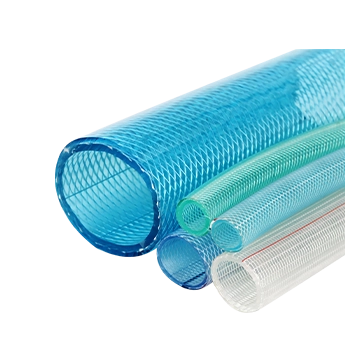
For small-bore pressure work, the same company lists a PU braided hose. It has a thermoplastic polyurethane tube and cover with a high-tensile polyester yarn reinforcement. Its published data includes:
- inner diameters of 5–12 mm
- 100 m rolls
- a working pressure of 20 bar and a burst pressure of 60 bar
- a temperature range of -40 °C to +100 °C
The two products have different jobs. They do not compete for the same application.
Quick selection checklist
| Buyer question | PU Anti-Sprial Hose (published data) | Action if unclear |
|---|---|---|
| What is conveyed? | Abrasive solids, sand, gravel, grains, particulates, static-generating materials | Send the medium details. Confirm chemical compatibility |
| Is static control needed? | Described as anti-static. No resistance value published | Ask for the electrical specification and grounding guidance |
| What bore size? | 20–250 mm ID | Confirm fit with your fittings and clamps |
| Is vacuum or suction required? | A vacuum column is listed, but the unit is unclear | Ask for the vacuum rating with its unit for your size |
| How tight are the bends? | A bending radius column is listed, but the alignment is unclear | Ask for the minimum bending radius for your size |
| What temperature? | -40 °C to 90 °C; up to 150 °C for a short time | Confirm the heat profile and duration |
| Is positive pressure needed? | Not published | Consider a pressure-rated hose such as the PU braided hose |
Next steps
To get a quotation or check suitability, send Hebei Kebing Import and Export Trade Co., LTD the following: the medium, the inner diameter, the required length, the temperature range, any vacuum or static needs, and the end fittings. Prices, lead times and certifications are not covered in the published product information. Confirm them directly with the supplier.
THE PEOPLE

About the author
THE COMPANY
Hebei Kebing Import and Export Trade Co., LTD
Ketong has focused on the professional hose, The company integrates production, sales, and scientific research into a new high-tech, polymer composite material plastic product manufacturer. The resin hoses produced by our company include pneumatic hoses, high-pressure hoses, air hoses-fluid hoses, garden hoses, fire hoses, steel wire hoses, plastic hoses, suction hoses Hundreds of varieties of dust pipes, ventilation pipes, etc; With more than a decade of experience in foreign trade, we are committed to strict…
About Us ↗Visit company website ↗YOUR NEXT STEP
Bring your brief. Start a useful conversation.
Use case, specification, quantity and delivery window: make the next conversation specific.
-
Flexible High Pressure Top Quality PU Pneumatic Tube Air Hose: Comparing Two PU Tube OptionsNewsNov.03,2026
-
High-Quality Flexible PVC Clear Hose from China: Compatibility, Sizing and Documentation FAQNewsOct.28,2026
-
Choosing PU Anti-Sprial Hose: Medium, Dimensions and Operating ConditionsNewsOct.24,2026
-
Choosing Plastic PVC Water Pump Suction Hose from a Cost-Effective PVC Water Hose Supplier: Medium, Dimensions and Operating ConditionsNewsOct.24,2026
-
Choosing ALUMINUM FOIL VENTILATION DUCT: Application Fit and Specification ChecksNewsOct.24,2026
-
Durable PU Steel Wire Hose from China: FAQ on Compatibility, Sizing and DocumentationNewsOct.24,2026
 Afrikaans
 Albanian
 Arabic
 Azerbaijani
 Belarusian
 Bengali
 Bulgarian
 Czech
 Danish
 Dutch
 Finnish
 French
 German
 Greek
 Hebrew
 Hindi
 Hungarian
 Indonesian
 Irish
 Italian
 Japanese
 Kazakh
 Korean
 Kyrgyz
 Lao
 Latin
 Lithuanian
 Luxembourgish
 Malay
 Mongolian
 Myanmar
 Nepali
 Norwegian
 Persian
 Polish
 Portuguese
 Russian
 Serbian
 Slovak
 Spanish
 Swedish
 Tagalog
 Thai
 Turkish
 Ukrainian
 Uighur
 Uzbek
 Vietnamese
 Welsh
 English







